

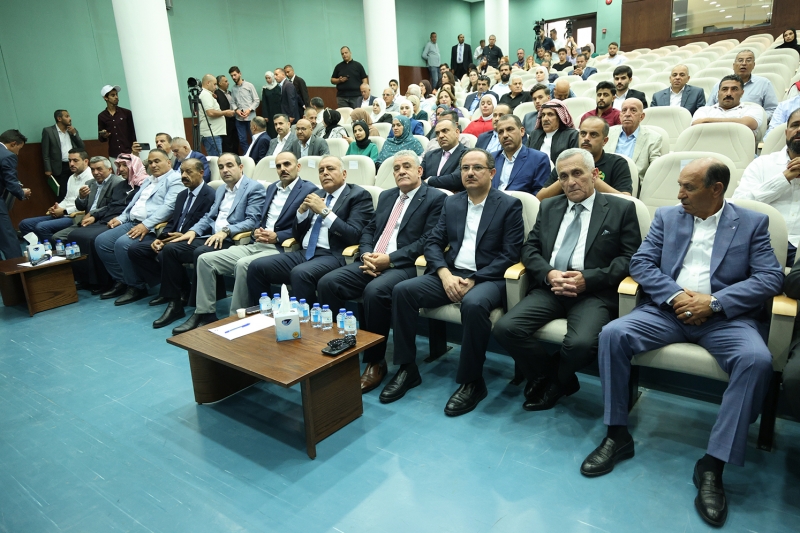
 German Jordanian University (GJU) hosted a panel discussion on Sunday titled "Jordan: Land and People – Madaba, the City of Mosaics, and Its Role in Shaping the Jordanian National Narrative," as part of the "Hiwarat" program, which stems from the Jordanian National Narrative Project, launched in implementation of the directives of His Royal Highness Crown Prince Al Hussein bin Abdullah II.
The seminar featured Secretary General of the Ministry of Culture Dr. Nidal Al-Ayasrah, Former Minister Nabil Al-Masarwah, Senator Mohammad Al-Azaideh, and Dr. Abdullah Al-Radawneh, while Poet Dr. Bakr Al-Sawadeh moderated the discussion.
During the seminar, attended by Madaba Governor Hassan Al-Jbour and President of GJU Prof. Ala’aldeen Al-Halhouli, Dr. Al-Ayasrah emphasized that the Jordanian National Narrative Project documents Jordan’s rich history and the civilizations that flourished on its land throughout the ages. He noted that the initiative contributes to strengthening the values of national belonging and citizenship, highlighting the achievements of the Jordanian state under the Hashemite leadership, and introducing younger generations to their country's history and cultural heritage.
He added that the project reinforces Jordanian national identity, showcases its deep historical and cultural roots, and reflects Jordan’s distinguished historical and humanitarian standing.
Dr. Al-Ayasrah also highlighted the rich history of Madaba, evidenced by its archaeological and historical landmarks, most notably the Madaba Mosaic Map, as well as its connection to Christian pilgrimage sites such as Mount Nebo and Bethany Beyond the Jordan (Al-Maghtas), in addition to many other significant historical sites.
He further noted that Jordan has been home to numerous civilizations spanning thousands of years, culminating in the establishment of the modern Jordanian state, underscoring the importance of developing comprehensive national content that reflects the Kingdom’s rich historical and cultural legacy.
For his part, Nabil Al-Masarwah reviewed Jordan’s historical development, tracing its roots from the Ammonite, Moabite, and Edomite civilizations through the Nabataean Kingdom, the Byzantine era, and the Islamic period, during which mosques and churches were built side by side, reflecting the values of coexistence and tolerance that characterize Jordanian society.
He also highlighted Jordan’s major transformations in the modern era and the remarkable progress achieved under the Hashemite leadership, as well as Jordan’s longstanding support for the Palestinian cause and the heroic role of the Jordan Armed Forces – Arab Army in the Battles of Bab Al-Wad and Latrun.
Meanwhile, Senator Mohammad Al-Azaideh discussed Madaba’s contribution to the Jordanian national narrative throughout history, emphasizing that the governorate represents a bright chapter in Jordan’s history thanks to its rich archaeological, religious, and tourist attractions, which have made it a destination for researchers and visitors from around the world. He stressed the importance of documenting the city’s history and preserving its cultural heritage for future generations.
He explained that Christian tribes settled in Madaba in 1880, having migrated from Karak, while the surrounding areas were inhabited by tribes from Al-Balqa and the Dhiban District. He also noted that the Greater Madaba Municipality was established in 1912, and that Madaba played a role in advocating for Jordan’s independence in 1946, when the municipal council signed a document addressed to Prince Abdullah bin Al Hussein, who later became the Kingdom’s founding monarch.
In his remarks, Dr. Abdullah Al-Radawneh addressed the social and cultural heritage of Madaba, highlighting the longstanding coexistence between Muslims and Christians in the governorate. He also reviewed some of Madaba’s most prominent social customs and traditions related to weddings, harvest seasons, and various community occasions.
The seminar concluded with an interactive discussion, during which participants raised questions that were addressed by the speakers. The dialogue focused on the importance of documenting Jordan’s national history and highlighting the rich historical and cultural heritage of Madaba and Jordan, thereby strengthening national identity and fostering a deeper sense of belonging and pride in the Kingdom’s history and development.